
Questions, answered
After years of raising Labs, here are honest answers to what families ask us most. Have a question we haven't covered? Drop us a line — we love to chat.
Getting ready for your puppy
Almost time to bring that brand new family member home? This is such an exciting time, but there are also so many questions — what food, whether to crate train, when the dog park is safe. We answer these and more below. (Some links below are affiliate links.)
What should I feed my puppy?
We feed our pups Purina One Large Breed puppy food, three times a day. You're welcome to switch to a food of your choice — just mix the old food with the new to make the transition easy on their tummy, and keep them on puppy-specific food until they are about a year old.
An eight-week-old puppy is similar to a newborn baby — growing constantly and needing plenty of nourishment. We recommend letting them free feed for ten minutes at a time, three to four times daily. As your puppy gets older, ask your vet for a portion recommendation or follow the guide on the food bag.
A spoonful or two of canned pumpkin and cottage cheese once a day is highly recommended for probiotics and healthy digestion. And for training rewards, most of our dogs prefer cheese or deli meat over store-bought treats — though dried liver bites are a reliable favorite.
How does housebreaking work?
Each of our pups begins the housebreaking process with us to give you a head start. Our puppies live in big indoor runs divided into a distinct "potty area" and "play area," so by the time they go home they have a good foundation for potty training. There will still be a transition to your home — that's completely normal, and with patience you can do it!
Good rules of thumb: take your puppy out immediately after they wake from a nap, and expect them to need to go about 30 minutes after eating. If your puppy wanders to a corner and starts sniffing, they're most likely looking for a place to potty.
While in the house, your puppy should be in one of three places: right with you where you can watch them (a leash helps), in their crate, or in a pen if they'll be alone for a longer stretch. After an accident, clean the spot with a scented cleanser and place the soiled towel where you do want them to go — animals return to the place with the right scent. We also love this odor eliminator for getting rid of smells.
Should I crate train?
Absolutely — crate training is something we believe in. Your puppy won't like it at first, but the crate eventually becomes their safe space for sleeping and alone time. Our puppies don't go home crate trained, but training can begin the day they arrive.
The most important thing is choosing the correct size. A dog instinctively keeps its living area clean — if the crate is big enough to potty on one side and sleep on the other, it's too big. Sized correctly, your puppy won't want to potty inside it. Something this size is recommended to start out with.
Consistency is key. Your puppy WILL whine — they need to learn that whining doesn't open the door. Make the crate enjoyable with nice toys, soft bedding, and a Kong stuffed with cream cheese or peanut butter, and they'll soon think of it as home. The whining won't last forever; you just have to outlast them.
What if I'm gone for longer stretches?
For workdays and longer errands, an exercise pen (X-Pen) with puppy pads or a litter box is a lifesaver. Set up the main area as their play space, a potty corner with pads or a litter box, food and water, a few toys to keep them busy, and a rest area with a crate or bed. It may take a few tries, but they will learn to be happy there too. Here's an article we recommend for more ideas on setting up this area.
Do I need a trainer?
A well-trained dog is a happy dog. Often — especially if you've had dogs before — a trainer isn't necessary. But we've heard story after story of an unruly puppy going to training school and coming back a different dog. If you're having issues, nip them in the bud: bad habits only get harder to mend as the puppy gets older.
How much exercise is safe?
We know — you're going to want to show that pup off. But remember: these are infants. Protect those knees and elbows! No high jumping, and no long walks, hikes, or running on cement until they're full grown.
Rule of thumb: no more than 5–10 minutes of rigorous exercise per month of age, twice per day.
What should I have ready for the trip home?
Not much! Have a leash and collar on hand in case you need a potty stop on a long drive. We send every puppy home with a blanket and our pups' favorite ball, so they'll have something cozy and familiar. You're welcome to hold your pup the whole way home — or use a travel crate with a grated bottom and puppy pads in the tray for easy cleanup.
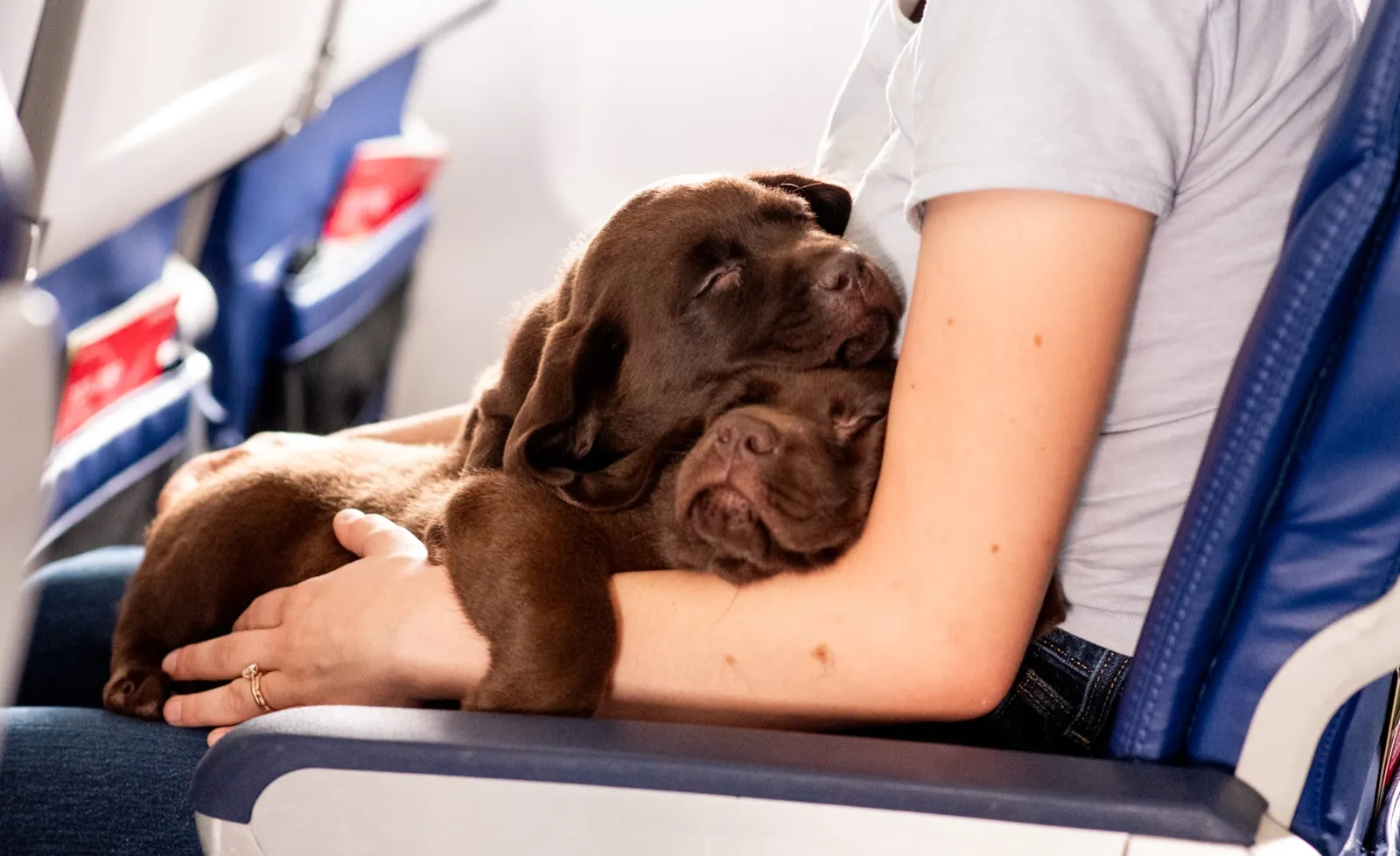
If you're flying your puppy home, we recommend the largest airline-approved soft carrier. We hold off food for at least six hours before the flight, and the engines usually lull the pups right to sleep. Keep a couple of spare puppy pads with you, and at the airport skip the pet relief areas — find a quiet corner and lay a pad down instead.
How do I introduce my puppy to other pets?
Our pups love other animals, but give your new puppy time to adjust to your home before making introductions — a few hours to a few days, depending on the pup. Start with a controlled setup, like a baby gate or kennel between them, so they can safely learn each other's scent. A first face-to-face meeting on neutral ground — a walk or a park — works better than inside your dog's territory. Keep the process gradual and supervised.
What health care will my puppy need?
Your puppy goes home vet checked, dewormed, and up to date on vaccinations, with a copy of their official vet record. Schedule your own vet visit right away — appointments fill up quickly, and finding the right vet will save you countless hours of worry.
Until your vaccination schedule is complete (generally around 16 weeks), do NOT take your puppy to dog parks, pet stores, or anywhere they could meet unvaccinated dogs.
We recommend waiting to neuter a male until at least 12–18 months, and spaying a female after her first or second heat (typically 10–14 months). Cutting off growth hormones too early can affect development — and the dog often won't fill out to that stocky English Lab look we all love.
How reserving works
From your first hello to puppy picks at seven weeks — a clear, step-by-step path to your reservation.
How do I start?
Contact us! We love to chat about our Labs — by email, phone call, or text. We'd love to hear about your dog experience, your house and yard situation, and all about you, along with the gender and color you're looking for and your timeline. We'll give you our recommendation based on what's available and what your ideal Labrador is — our goal is the perfect match for every family.
We receive applications every single day and do our best to respond to every one, so please allow 24–48 hours for a reply.
How does the reservation work?
If we have puppies currently available, we require a $700 deposit to reserve. The deposit is nonrefundable and is deducted from the total cost of your puppy. Total cost depends on parentage, coloring, and gender — contact us for details.
Zelle or Venmo are our preferred payment methods, though we can take a credit card, debit card, or bank transfer with corresponding fees. Our purchase documents and health guarantee are sent through Adobe to make signing easy and convenient.
If we don't have the puppy you're looking for right now, we highly recommend joining our waitlist for upcoming litters.
How do puppy picks work?
Once your litter arrives, we send photo and video updates at two, four, six, and seven weeks of age. Puppy picks are made in the order deposits are received, when the litter reaches seven weeks — after their vet checkup, and the age when the pups are most mature in looks and personality.
To get ready, you'll receive 4–5 individual photos of each puppy at six weeks, and at seven weeks a 2–4 minute video where we discuss each puppy and their temperament. Zoom or FaceTime calls are also an option! Picks must be made within 24 hours of the final videos going out, in consideration of everyone else on the list.
What does my puppy go home with?
All of our puppies go home with limited AKC registration (breeding rights are potentially available — contact us if interested), proper deworming, vaccinations, and vet checkups, and our two-year health guarantee. Every pup also heads home with a blanket, a favorite toy, and some food to get them started. We don't routinely microchip, but we can upon request.
And we're available to answer questions and address concerns long after your puppy has joined your family. Pictures and puppy updates are ALWAYS welcome!
When is gotcha day, and how does payment work?
Puppies are ready to go home at eight weeks of age, following a clear health check by our veterinarian. When the puppies reach six weeks, 50% of your remaining balance is due, with the remainder at eight weeks when the pups go home (full payment at eight weeks if we're boarding your puppy longer).
We accept Zelle, Venmo, credit card, debit card, or bank transfer for final payment — and cash if you're picking up in person. If we're flying your puppy to you, we ask for payment within 24 hours of the scheduled takeoff.
How the waitlist works
We don't always have puppies available — and adding your name to the waitlist is the best path toward your perfect future Happiest Labrador puppy.
Why join the waitlist?
- Be offered new puppies before the general public.
- Get personal updates when new litters have arrived.
- Stay on as long as you need until we have the perfect puppy for you.
- Don't lose your spot in line if a certain puppy doesn't work for you.
- Get a full refund if we are unable to offer you a puppy of your chosen gender and color within a year.
How do I join?
Contact us to officially get the process started. We require a $350 deposit and the signing of our Deposit Agreement to join. You'll select the color and gender you're looking for (you can choose multiple, and change your preferences later) — the more flexible you are, the sooner we can offer you a puppy. Spots in line are reserved in the order deposits are received.
Your $350 deposit is the first payment toward the total purchase price of your limited-AKC-registration puppy. Limited registration means your puppy is purchased as a pet only — if you're interested in breeding rights, let us know before placing a deposit.
If we're unable to offer you a Labrador of your chosen gender and color within a year of your deposit, you're eligible for a complete refund. If we do offer one within the year and you decline — due to the parents, pricing, timing, or personal matters — the deposit becomes nonrefundable when the year expires. Either way, you can keep your spot on the waitlist for as long as you'd like.
What happens when a litter arrives?
Once a litter is born, we take about two weeks to ensure the health and stability of our fragile babies before notifying the waitlist. You'll ONLY be notified if your selected colors and genders are available — with details on the parents, the colors and genders, and the price. First Pick hears first, and each family has up to 24 hours to either move their deposit onto the litter or keep their spot and wait for a future litter.
Passing on a litter does NOT bump you to the bottom — you keep your place in line until you choose to move your deposit to a litter. Please note that we reserve the right to keep back a puppy or puppies from each litter for our program, and we keep everyone apprised of those details as early as possible.
How do I make my choice permanent?
Once we have the perfect litter for you, an additional $350 moves your deposit off the waitlist and makes your choice permanent. You'll sign our Purchase Contract, Deposit Agreement, and Health Guarantee to make the reservation official — and from there, everything proceeds just like a standard reservation.
Hand delivery, nationwide
Even though we are located in Tennessee, we have Happiest Labrador families all over the US. Thanks to our phenomenal transportation team, hand delivery anywhere in the United States is possible, convenient, and stress free.
Do you deliver near Tennessee?
We live out in the beautiful Tennessee countryside, about two hours east of Nashville — so we offer delivery within two hours of our location completely free. If you live within that radius, we can deliver directly to your home, or we can meet you partway if you live further out. Let us know your location before you reserve and we'll work out the options together.
How does flying work?
If you're not within driving distance of us, flying is the perfect option. We've worked with an amazing transportation team for years — highly competent, easy to work with, and dog lovers through and through. On delivery day, your puppy is driven to the airport and entrusted to their flight nanny, at whose side they stay for the entire journey.
Our pups are NEVER flown cargo. They fly in-cabin, in a carrier under the seat in front of the nanny, in their constant care until placed in your arms at your nearest major airport.
Flight-nanny delivery is an additional $750, which includes the plane ticket, the airline pet fee, and the nanny fee. Safe, convenient, and stress free — for both you and your puppy.
What is a fox red Labrador?
Are they purebred? Are they recognized by the AKC? Are they just a color fad? Answering your questions below.
Is fox red a separate color?
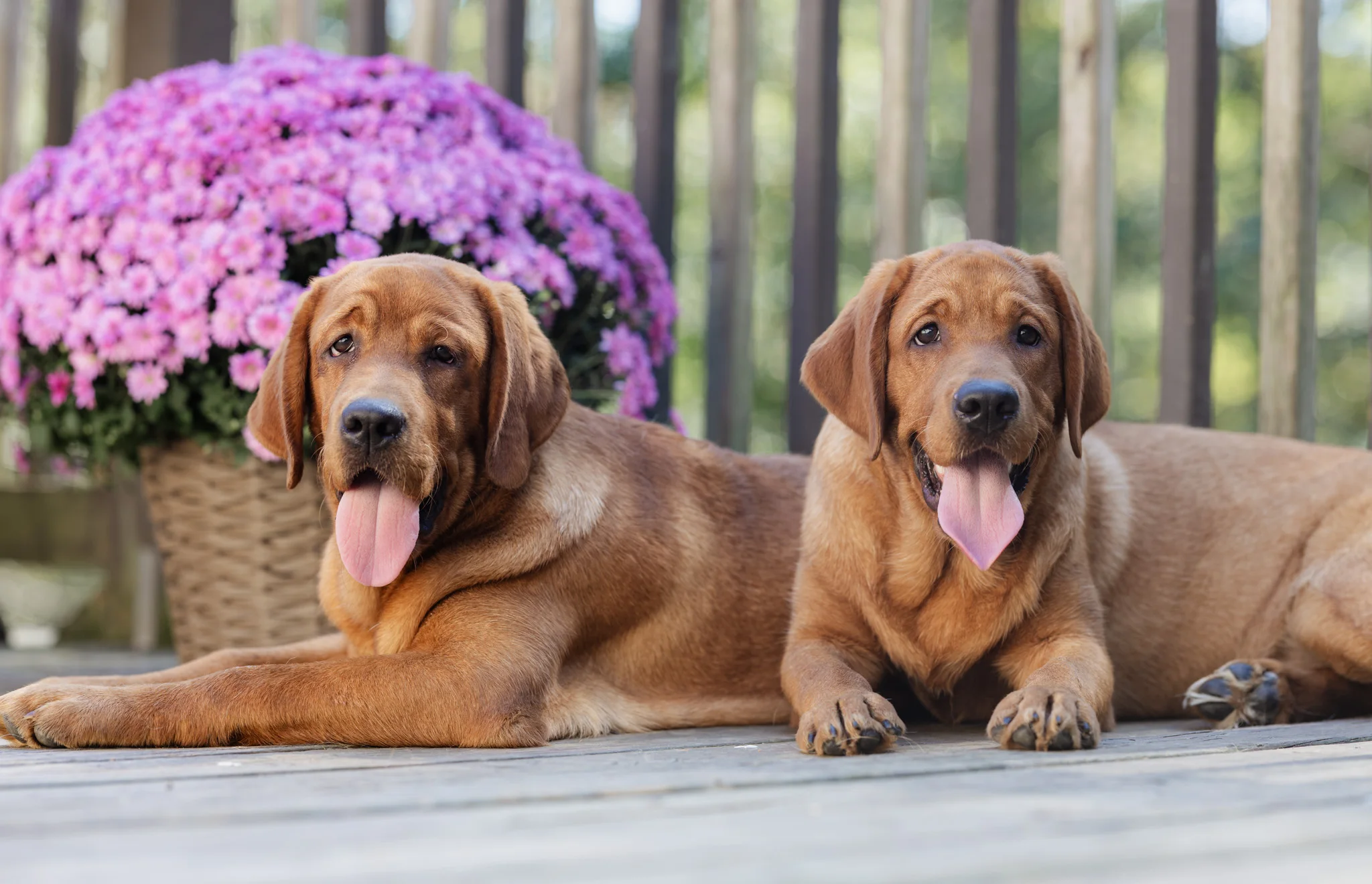
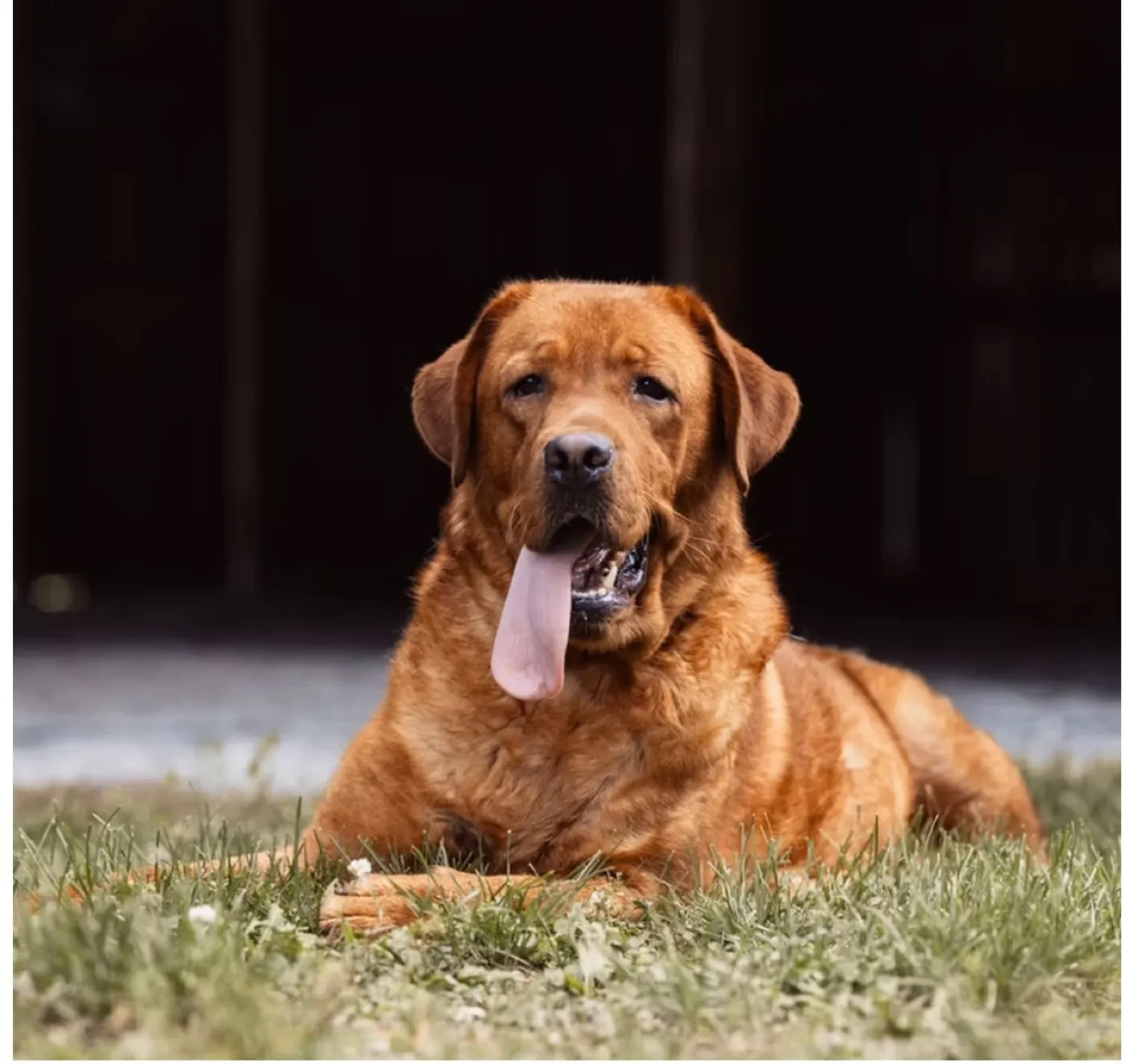
A fox red Lab is simply a yellow Lab with very dark pigmentation — there is no "red" gene. The same gene produces a range from so-called "polar white" through yellow all the way to the darkest shade, fox red. Think of golden retrievers ranging from deep red to cream: it's the same idea with Labradors. Lighter yellow parents generally produce lighter puppies, and deep fox red parents produce dark red puppies.
Are fox red Labs purebred?
YES. Fox red Labs were not created by mixing in another breed — they're produced by breeding darker and darker yellow Labs to each other. A fox red Lab is essentially a very dark yellow Labrador, and therefore purebred.
Are they recognized by the AKC?
Again, yes — there have been quite a number of fox red Labrador Retriever AKC Grand Champions. The AKC has always recognized them as purebred Labs. When registering, simply mark "yellow" in the color box, as that is the technical definition of their coloring.
Is fox red just a fad?
Quite the opposite — dark yellow and red Labradors were the most desirable shade for hunters in the first half of the 1900s thanks to their natural camouflage: a black Lab stands out by day, a light yellow Lab is easily seen at night, but fox red blends right into the landscape. The color fell out of favor in the US until around the 1980s, when breeders began importing European dogs of that color and reintroducing it into their lines.
Once you meet a fox red Labrador in person, as we first did almost ten years ago, it's almost impossible to forget what a beautiful dog it is. We are so thrilled to have added this color to our program.